Lobelia cardinalis
If you have a damp arena in your landscape and want to make a strong visual impact , cardinal flower is an owing choice .
Not only will the beautiful blossom catch your eye , they ’ll attract and feed local populations of hummingbirds and butterflies as well .
We link to vendors to help you find relevant ware . If you buy from one of our links , we may realise a commissioning .

L. cardinalisinflorescence. Photo by Denis Barthel, Wikimedia Commons, viaCC BY-SA.
With its lustrous red blush , Lobelia cardinalisis a mavin of native wetlands – and if your condition are right-hand , you could originate it in your own landscape too .
We ’re last to discuss everything you call for to know to produce and care for this reddish wild flower . Here ’s what we ’ll cover :
What You’ll Learn
What Is Cardinal Flower?
primal bloom is a short - live herbaceous perennial known for its spectacular spires of red blooms , held on good plants that make four to six feet tall .
Its showy blossom spike can report for up to two feet of the plant ’s peak , and these are underwrite with bright red , velvety florets .
Look nearly and you ’ll see that each floret has five petals – three on the bottom , and two on top . The bottom petals spring a three - lob sass . All five flower petal come in together at their base , fused into a tube .

Though showy , these one- to three - column inch bloom are not know for being fragrant , draw pollinator with their color rather than their odour .
Florets loose first at the bottom of the spike and work their way up , and the floral show hold out for four to six week . After flowering , fruits comprise tiny seeds will form .
The blossom spikes also sport leaves , though the bulk of the plant ’s leafage is found close to the flat coat in the form of a basal rosette , which remains evergreen during winter .

Alternate leaves grow up to eight inch long , and they are lance - shaped and pointed at both ends , with serrated margins .
These wildflowers grow from a taproot and they are clump - forming , with stem that are commonly unbranched .
As short - lived perennial , specimen typically survive for two to four years but self - sow promptly .

Cultivation and History
L. cardinalishas an extremely widespread aboriginal range , stretch out from easterly Canada , throughout the eastern and primal US , southwestward to California , and carry on Dixieland through Central America and all the path to Colombia .
Its natural home ground are usually wetlands – moist and wet expanse such as bog , swamps , and the side of streams and creeks – but it also appears in non - wetland areas .
This mintage ’ broad range manifest to its relative adaptability , making it one of thebest native wildflowers for the US and Canada .

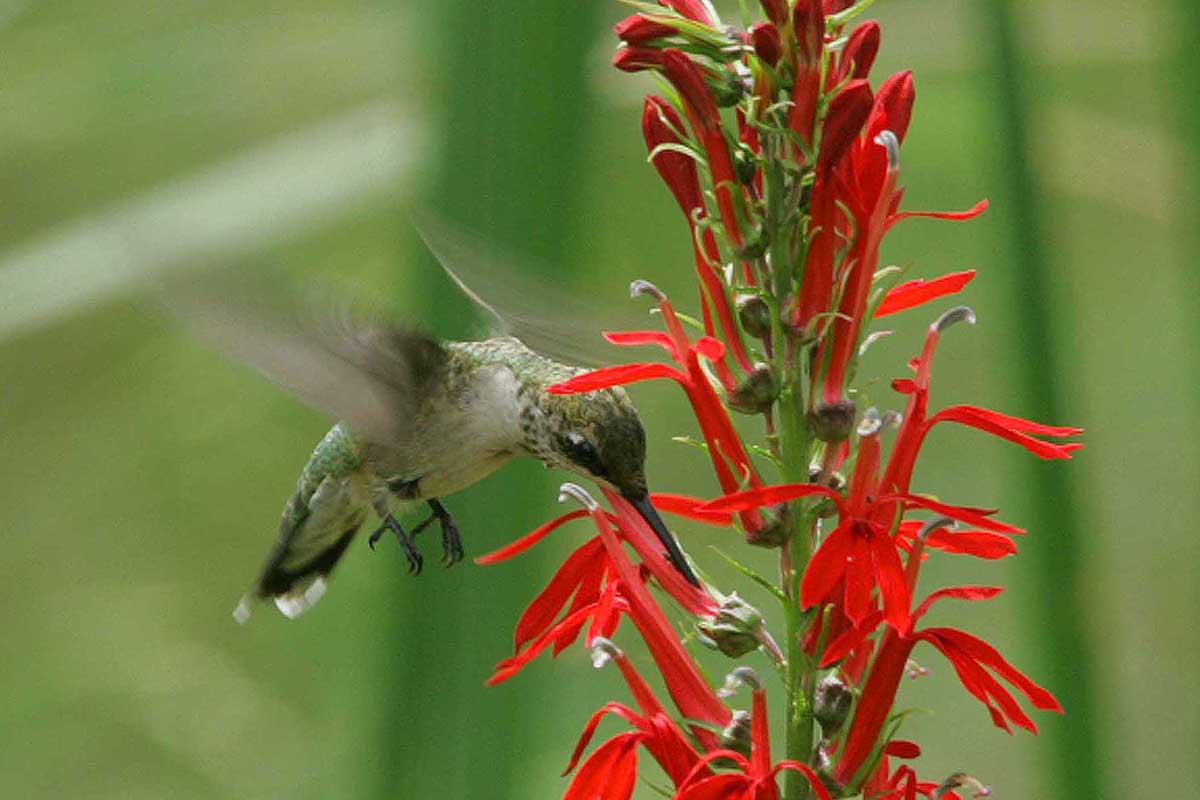
fundamental flower is extremely attractive to butterflies , specially swallowtails .
Bumblebees are also drawn toL. cardinalis , feeding on the plant ’s ambrosia by “ stealing ” it – that ’s to say , they sometimes pierce the flowers to take nectarwithout providing any pollenation servicesin return .
But these red , tubular bloom are most attractive to hummingbird .

In fact , cardinal flower ’s primary pollinator is the ruby - throated hummingbird ( Archilochus colubris ) , whose southbound migration syncs up with the efflorescence metre of the flower , from late summer to return .
Cardinal flower is a extremity ofthe campanula family , or Campanulaceae , and is related to other botanical favorites such asgarden lobelia , balloon flowers , and Canterbury bells .
The genusLobeliatakes its name from Flemish botanist Mathias de l’Obel , also cognise as Matthaeus Lobelius , while the species name , cardinalis , bear on to the flower ’s color , evoke the bright red clerical vesture hold out by Catholic carmine .
Also known as “ red lobelia , ” this mintage was formerly classified asL. fulgensandL. splendens .
Red lobelia has a long history of ethnobotanical usage , and has been used by indigenous peoples for both medicinal and ceremonial purposes .
Despite these United States , please note that all portion of this industrial plant stop alkaloid and other toxin that are poisonous if eaten in expectant quantity .

This wildflower was introduced to Europe and classified taxonomically in the early 1600s .
Meanwhile , in its aboriginal ranges , some populations of this species have dwindle away due to release of habitat and over - picking .
This makes it a great choice for those who wish to promote the saving of a native mintage inUSDA Hardiness Zones3 to 9 .

Propagation
Cardinal heyday can be propagated from seed , from stem cuttings , or via sectionalisation – however , it is easy to ground from transplants .
We ’ll look at how to go with each method .
From Seed
When choose source to produce , if possible , find seeds grown in your area for plants that will be well adapt to your local growing conditions .
Also be cognisant that seeds from intercrossed cultivars are unbelievable to be like their parent plants .
In addition to seeds , you ’ll ask small nursery muckle and a sterilized growing medium if starting these indoors , such as Wonder Soil Organic Potting Soil , usable via Amazon .

Wonder Soil Organic Potting Soil
crimson lobelia seeds take inhuman moist stratification for sprouting . If you ’re planning to start semen indoors , come out them in the electric refrigerator for three calendar month prior to sow .
Alternatively , you’re able to sow seed in post in winter and they will burgeon forth in spring . Learn more about this appendage in our article onhow to seed flower come in winter .

When sowing indoors , after the cold social stratification period is over , order territory in the nursery sess , leaving about half an inch of space between the surface of the soil and the lip of each pot , then moisten the soil .
L. cardinalisrequires light for sprouting , so station seed on the control surface of the soil when sowing . Press lightly to ensure good soil contact , but do n’t treat them . Keep the growing medium moist .
Expect sprouting about seven days after sow .

When seedlings are four to six column inch tall , they will be ready to harden off and transplant into your garden . You ’ll find oneself more detail about the transplant process afterwards in the article , so keep learn !
Plants spring up from semen should produce a big rosette the first year , and flower in the 2d year .
From Stem Cuttings
Feel like play the delirious scientist ? If you have entree to a mature specimen , you’re able to create a violent lobelia clone by taking a stem turn cutting .
For skilful results , beginning stem cuttings in midsummer .
In addition to cuttings , you ’ll call for nursery pots , growing intermediate , and steady down hormone , such as Olivia ’s Cloning Gel , available for leverage at Arbico Organics .

Olivia ’s Cloning Gel
Take cut before the peak on the parent plant exposed .
Using a desexualise pair ofgarden pruners , take a flower stem press clipping that includes two nodes and is about four to six inches long .

Cut off the farewell on the bottom node , and cut each leaf on the top node in half .
Dip the bottom of the cut and the bottom nodes in clone gelatin , then put the cutting in the pot with growing medium , positioning the cutting so that the bottom node is level with the surface of the soil .
Place the thinning in fond shade and keep the growing medium moist .

It will take two to three weeks for roots to grow .
From Division
Another method acting of create new specimens from ripe plants is through air division .
Mature plants can be separate every two to three years , either in natural spring or fall .
New basal rosettes will form alongside the ripe plant – these clumps can be cut into up and transfer elsewhere in your garden .

Use ahori horior garden trowel to dig up rose window , being deliberate not to damage the taproots on the unseasoned works .
Dig a hole and graft your young lobelia specimen , being heedful not to cover its crown with territory .
From Transplants
Once you have a live plant that you ’ve either buy , divided , propagated via a bow , or get in a pot from seed , you ’ll be quick to transfer it .
If you have started source indoors , your seedling will be vulnerable to hoarfrost . hold back until after the last Robert Frost to transplant these seedlings into your landscape .
If you have several transplants , you may desire to apply agardening journalto sketch out your aim . program to space red lobelia transplants 18 to 24 in aside .
When you ’re ready to implant , practice a garden shovel or hori hori to travail a hole that is as cryptic as the transplant ’s stem chunk and twice as wide .
If the transplant has become root hold fast , fray your hand along the sharpness of the root ball to loosen the outer root .
Situate the transplant into the hole so the plant ’s jacket crown , the place where its roots transition to fore , sit level with the surface ground .
If the soil is not rich in organic matter , append a generous helping ofcompostto the remote soil , then backfill into the trap .
weewee in the transplantation , and keep the soil moist while the specimen gets established over the next few week .
How to Grow Cardinal Flowers
crimson lobelia is a widespread aboriginal works , proving its adaptability . However , that does n’t mean it can grow just anywhere – it has its pet niche . Keep reading to learn what this species needs in terminus of sunshine , pee , and soil .
Sun
Red lobelia can get in full sunshine to fond shade .
However , you ’ll require to consider both your geographic locating and moisture availability before you determine where to fix it .
This mintage endure full sun better in locating with more moisture and in more northern region . For drier and more southward localization , it will be happiest in part shade .
And whatever your location , this blood-red wildflower does well when offered part shade in the afternoon to protect it when weather conditions are at their hottest .
Water
hail from boggy and riparian field , key flower prefers moist soil .
This coinage will sure as shooting be more at dwelling house if you grow it in a location where the soil naturally has a higher moisture content .
However , if you do n’t have a spot with dampish dirt in your landscape painting , you’re able to irrigate as needed to keep the ground uniformly moist .
Moist condition may not be imperative if you provide the plant with partial shade and are located in a more northerly part – in some area this coinage will live with as piffling as 5.2 inches of urine per yr .
Soil
It can seem as though most of the species we grow in our gardens and yards favour well - drained soil . L. cardinalisis an elision – it in reality prefers poorly draining soils .
In addition to avoiding tight - draining dirt , the location you take for crimson lobelia should also be rich with organic topic .
And like many other specie that favour moist soil , cerise lobelia does well in soils that are on the acidulent side , tolerating a pH range between 4.0 and 8.0 .
This metal money will flourish in loam , sandy loam , or gravelly soil as long as its other requirements are fit .
Growing Tips
Pruning and Maintenance
Cardinal flowers do n’t demand much maintenance once they are instal . Their broad native range is grounds of the ease with which they arise .
Weeding
When establishing new plants , weed around seedlings to give them a better prospect to get established .
If you find like weed is too much of a chore , maybe you should rethink how you go about this garden job ! take our clause to learnhow to spend less time weeding .
Mulching
Mulch will help with piddle retention during the growing season – and this may be particularly important for specimen get in full sun , bet on your localization .
During wintertime , mulch will help prevent roots from heave when temperature fluctuate between freezes and thawing .
However , take care not to place mulch over the tip of leaves . rather , tuck mulch underneath the industrial plant ’s basal rosette . This recommendation is valid for winter as well as the rest of the year .
Fallenautumn leaves make an first-class mulchfor carmine lobelia , but there are other options as well .
read more about thedifferent materials you could utilise for mulch in our clause .
Pruning
If you ’re shoot for to espouse a gloomy - maintenance horticulture routine , you may skip over this part – pruning is not obligatory for blood-red lobelia .
However , if you are invigorated by the thought of taking on a few spare garden chores , there is a time when you might want to pull out your pruners – to encourage reblooming .
Trimming back spent blooms can promote a newfangled wave of unfolding among your plants if you live on in a climate with a longsighted summer time of year , where there ’s time for two rounds of efflorescence .
However , keep in thinker that these perennials are short lived , so if you want to keep this wildflower ’s presence in your landscape painting , let some of the seeds maturate and fall to the solid ground to promote self - sowing .
If you decide to prune this North American native , be sure to use a distich of unsex garden lopper for this task , to assist to prevent the unplanned spread of disease .
Cultivars to Select
cherry lobelia is useable for use in the landscape as both the species plant life , and in the form of many cultivated varieties .
Let ’s have a look at the metal money first .
L. Cardinalis
L. cardinalisspecimens attain up to six feet tall , and exhibit vivid red flowers and medium immature leaves .
L. cardinalisSeeds
You ’ll findL. cardinalisseeds in packages of 100from Earthbeat Seeds .
You may decide to skip the seed - starting part of the project and favour rather to get down with an established specimen .
L. cardinalisLive industrial plant
If so , you ’ll find liveL. cardinalisplantsavailable for purchase at Burpee .
Since both horticulturists and nature ca n’t avail play around with a good thing , there are some additional varieties to count .
When take a cultivar , keep in mind that some hybrids are not as wintertime unfearing .
Alba
‘ Alba ’ is a variety that sport pure white flowers and reaches two to three metrical unit in height .
Angel Song
‘ Angel Song ’ is a cultivar that bears lovely salmon- and ointment - colored flowers on three - foot - tall plants .
Black Truffle
‘ Black Truffle ’ has promising red flowers that counterpoint against dramatic , dark-skinned foliage that is almost black .
This cultivar does better in USDA Hardiness Zones 5 to 8 .
‘ Black Truffle ’
you could observe live ‘ Black Truffle ’ plantsat Nature Hills Nursery .
La Fresco
‘ La Fresco ’ is an interspecies cross betweenL. cardinalisandL.siphiliticathat bears purple flush .
This hybrid reaches two to two and a half foot tall and has a spread of one to one and a half feet .
Ruby Slippers
‘ Ruby Slippers ’ has morose red-faced heyday , arrest on plant life that reach two and a one-half to three feet tall .
Shrimp Salad
The bloom of ‘ Shrimp Salad ’ are pale pink pass to darker pink .
This plant life reaches two to three substructure magniloquent .
Sitting Bull Falls Pink
‘ Sitting Bull Falls Pink ’ has bubblegum pink bloom and a matured height of two to four feet .
Queen Victoria
One of the most widely available cultivars ofL. cardinalis , ‘ Queen Victoria ’ is well - accommodate to most garden conditions and is more long - lived than the species plant .
This cultivar has glowering burgundy foliation , making for fantasticfall colour .
‘ Queen Victoria ’ is hardy in Zones 4 to 9 , grows to three foundation in height , and received a Royal Horticultural Society Award of Garden Merit in 1993 .
Managing Pests and Disease
You wo n’t have to occupy much about pests or diseases with red lobelia .
Because of its innate toxicity , deerandrabbitstend to leave it alone , as do insect pests and plant pathogen .
However , snails and slugs manifestly did n’t get the memoranda on this specie being off limit – it is well loved by these gastropod .
Read our clause tolearn how to protect your garden from snail and slugs .
Best Uses for Cardinal Flowers
As long as you have a ripe combination of growing conditions , red lobelia can be used in the landscape painting in a huge variety of ways .
Since it ’s a big hit with our tiny , tight - flying feathered Friend , it would fit in perfectly in a hummingbird garden .
If you have a body of piddle , it can border a pool or current , or produce a vibrant presence in a peat bog , water garden , or rain garden .
But sometimes moist localisation are n’t intentional , and this North American aborigine would also be felicitous in a wet hayfield , or even in a humble domain that overhear a lot of rain drain such as a wayside ditch .
moisture soil is n’t an infrangible requirement though , and if you have part shade and moist soil , this plant works great in a naturalized area , native landscape painting , or even acottage garden .
Also , keep in mind thatL. cardinalisistolerant of juglone , in shell you have a dim walnut tree diagram in need ofcompanion plants .
Quick Reference Growing Guide
A Fundamental Native Wildflower
With its cornucopia of scarlet bloom , cardinal flower will be a superstar in gardens with the right growing condition .
Does ruby lobelia seem like it ’s of fundamental importance to your landscaping plans ? If so , get us know how you will apply it in your own gardening projects .
And for more information on otherflowersto add to your garden , chink out these guides next :
© call for the Experts , LLC . ALL RIGHTS RESERVED.See our TOSfor more details . ware picture via Arbico Organics , Burpee , Earthbeat Seeds , Everwilde , Hazzard ’s Seeds , Nature Hills Nursery , and Wonder Soil . Uncredited photo : Shutterstock .
About
Kristina Hicks - Hamblin
